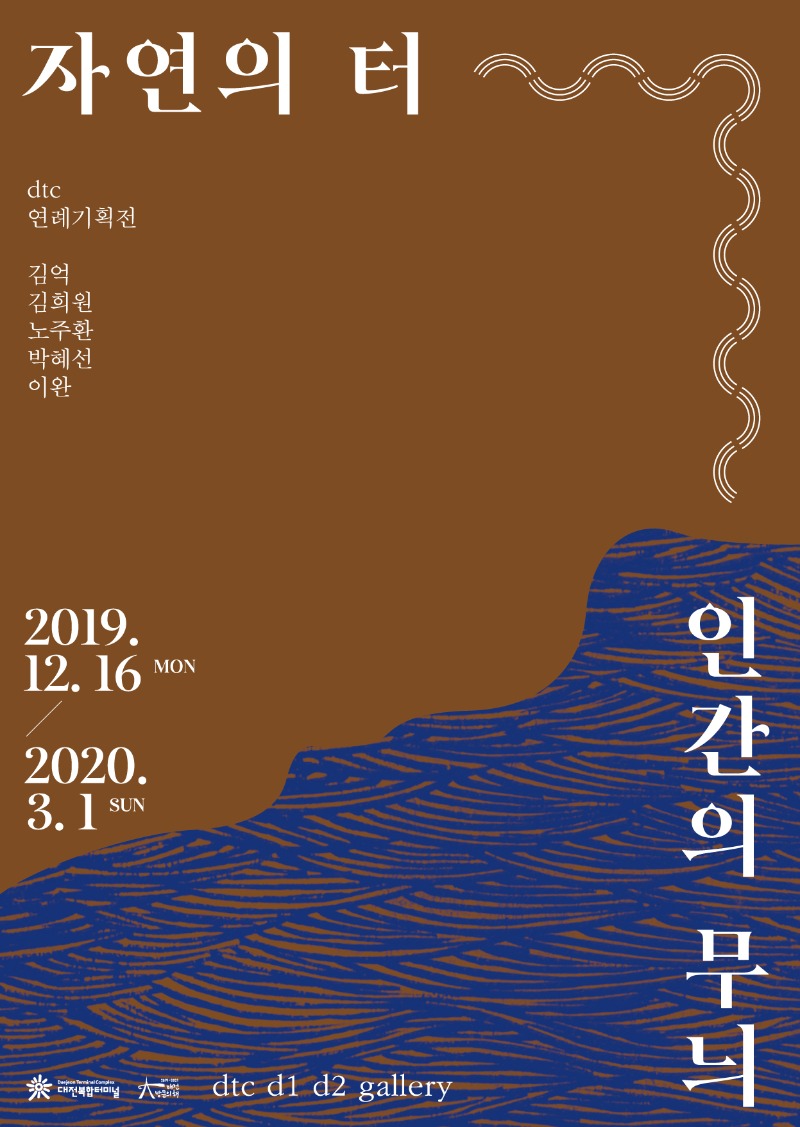
| Period| | 2019-12-16 - 2020-03-01 |
|---|---|
| Operating hours| | 11:00-18:00 |
| Space| | DTC Gallery |
| Address| | 1689, Dongseo-daero, Dong-gu, Daejeon, Republic of Korea |
| Closed| | Open throughout the year |
| Price| | Free |
| Phone| | 042-624-5535 |
| Web site| | 홈페이지 바로가기 |
| Artist| |
|
정보수정요청


|
|
Exhibition Information
			The theme of this exhibition, Nature's Site, Human Pattern, is an exhibition that tries to reflect on the meaning of the diverse art culture that humans have created and encountered in the flow of time and space. This image-language is a medium that allows one and the other to communicate with each other, allows one community to collaborate with another, and enables a variety of communication and exchanges by forming a global network, thereby promoting the prosperity of the global life, including humanity, and the development of a harmonious civilized society. And this was responsible for the record of passing on the history of the Han generation to the next generation, so that we could store the knowledge and wisdom of our humanity accumulated from tens of thousands of years ago in our present bodies and minds.
Image-Language is the unique culture of mankind created by the intense response of nature and human patterns, a code to read the times, and an aphorism to pass on to future generations. The five artists invited to this exhibition, Kim Muk-won, Kim Hee-won, Noh Joo-hwan, Lee Wan and Park Hye-sun, are working to remind us of the harmonious whole before the confrontational distinction between nature and human beings through their images - through the human patterns that we portray today through language.

Biography

Kim Eok
Kim Eok is a writer who carved a bar of his own body into a tree and transcribed it on Korean paper.
His works reflect the natural scenery of Korea, its history, and the division of our lives that has endured the waves. In the production of his own work, the real-life survey, which appears like a principle, is actually an attempt to learn from the body, the mind, the mind and the spirit of his work, and is soon linked to any place-specific weight, grandeur and grandeur that appears in his work. It's not that it puts on any airs as if it's mystical and inspirational, but rather that it evokes a sense of elasticity and awe in itself.
For example, his latest work <Southern landscape> features works produced after a detailed survey of Haenam’s emoji, which he sees in detail, as well as expressions of the terrain and stories in each of those places are packed with eggs. In addition, the anti-depression method, Geun-kyung, Jung-kyung, Won-gyeong, Samwon method, the timely management position of the structure, the mountain range's energy and the voluptuous flow of his writing style can be regarded as the highlight of his work.

Kim Hee-won
Kim Hee-won attempts to bring real scenery into the landscape of our lives.
It places natural landscapes into artificial spaces in the city center. Sometimes the images are captured over a long period of time and space. His signature works include <Someone’s Window>,  <Somebody’s Eyes> series, and a series of videos, door series and mirrors that even let the candle in the chandelier disappear. In 2018, the museum held an exhibition titled <The King’s Eye> at Yeongchunheon, Changgyeonggung, which features architectural beauty and beauty of Korean palaces, as well as Cha Kyung-jeok, which attracts natural beauty and its surroundings.
The author shows the characteristics of being able to empathize with others about the natural or artificial landscape that others are looking at. For writers who are mainly engaged in writing in foreign countries, they should always be in a position of being an entrant, a niche, or a cultural alien to the social culture of Korea and to the writer who is standing on the border. This experience may have always made him more interested in other people's lifestyles, and more interested in the changes of the times, the changes of the seasons, the weather or events, and the long-term observance and record of the lives of people living in them.

Noh Ju-hwan
Noh Ju-hwan uses the metal type of our words and writings as the material for his works to combine epigrams, proverbs and advice that serve as a model for our lives in the form of books, columns, and boxes.
ndividual words, words, do not have meaning in themselves, but if you combine words that are strangely popping up, you will naturally connect to the horizontal and vertical axes and form a sentence structure that has one meaning.<The pillars of wisdom>, and <the books of wisdom> lend these forms to the free combination of words and represent the epigrams of life.
Also, the compositional forms of writing and works that focus on structural characteristics, such as <The Wisdom of the Han River> and <the City of Typography>, bring together typecasts to suggest the place of our lives. Each of the small characters forms a unique structure of the letters, and as these small units form a small colony and gradually expand into the next large cluster, they form a unique pattern of land. Using these characteristics, the team is currently working to capture images of areas that share the same pattern and texture of their lives, such as the Seoul area and the Han.

Park Hye-sun
Park Hye-sun is in the process of finding her own new modern typeface based on the aesthetics of traditional calligraphy.
Through the process of reliving the epigrams or poems of life that he cherishes, and the precious moments and records in our history into his handwriting, the meaning and meaning of the book are felt again at this time of the day. The artist's latest works are inscribed on hanji with materials related to the independence movement of Joseon and the typeface and advice of teachers who guide his study of handwriting.
The exhibition will feature works that show the characteristics of modern calligraphy by combining <Long Live the Independence>, <Listen to the Declaration of Independence>, <The Silence of him>,Han Yong-un by the poet of resistance, <The Reason Love You> and Chusa Kim Jung-hee’s emphasis on calligraphy aesthetics, teaching of calligraphy and various objects.
Calligraphy is not just a collection of any sentence or writing, but an important medium in which one and the person communicate and sympathize with its meaning. Just as there are good words and sincere words among the words we speak, there are good handwriting and careful handwriting that are full of heart and soul for the beholder. The author makes us feel the meaning, meaning and will of independence contained in the Declaration of Independence through a simple, smooth, yet tasteless font.

Iwan
Iwan's handwriting is as it should be. He doesn't pursue good-looking, stylish and antique calligraphy aesthetics.
He writes a word or a sentence in the form of the word. For example, in case of his work <Big and Small>, he draws big bigger and small smaller.
The same goes for works. Instead of the cliche beautiful or cute or adorable well-designed writing of the word "love," it tries to capture the "human love" itself, which is full of human sandal-chilts (joy, anger, sorrow, fear, love, hate, and desire).
In addition, the composition and combination of the letters on the flowerbeds are also jagged, full of mischief, but the weave is as natural as if it fits perfectly. So his handwriting has the nickname "unpretty handwriting."
The writing combines a bold and bold, yet deep taste with a sense of dignity and a humility. The author is concerned that the strange fonts, which are bound by the formalism of tradition, the fonts of fat, glossy, greasy or full of spirit, and the fused fuses of tradition and modernity, are deceiving our sense of beauty. The writer never stops trying to give variety to the province of calligraphy, the aesthetics of calligraphy that follow the fashion era of formalized typewriting. The great taste lies in simplicity. Completely accomplished may seem inadequate, but there is no shortage of use.


 Naver
Facebook
Kakao story
URL 복사
Naver
Facebook
Kakao story
URL 복사


